October 26, 2025 • 7 min
How Agentic Systems Will Redefine Enterprise Productivity
Explore how agentic systems and Cygnus AI transform enterprise productivity with adaptive, asynchronous, and human-centric automation built for real-world workflows
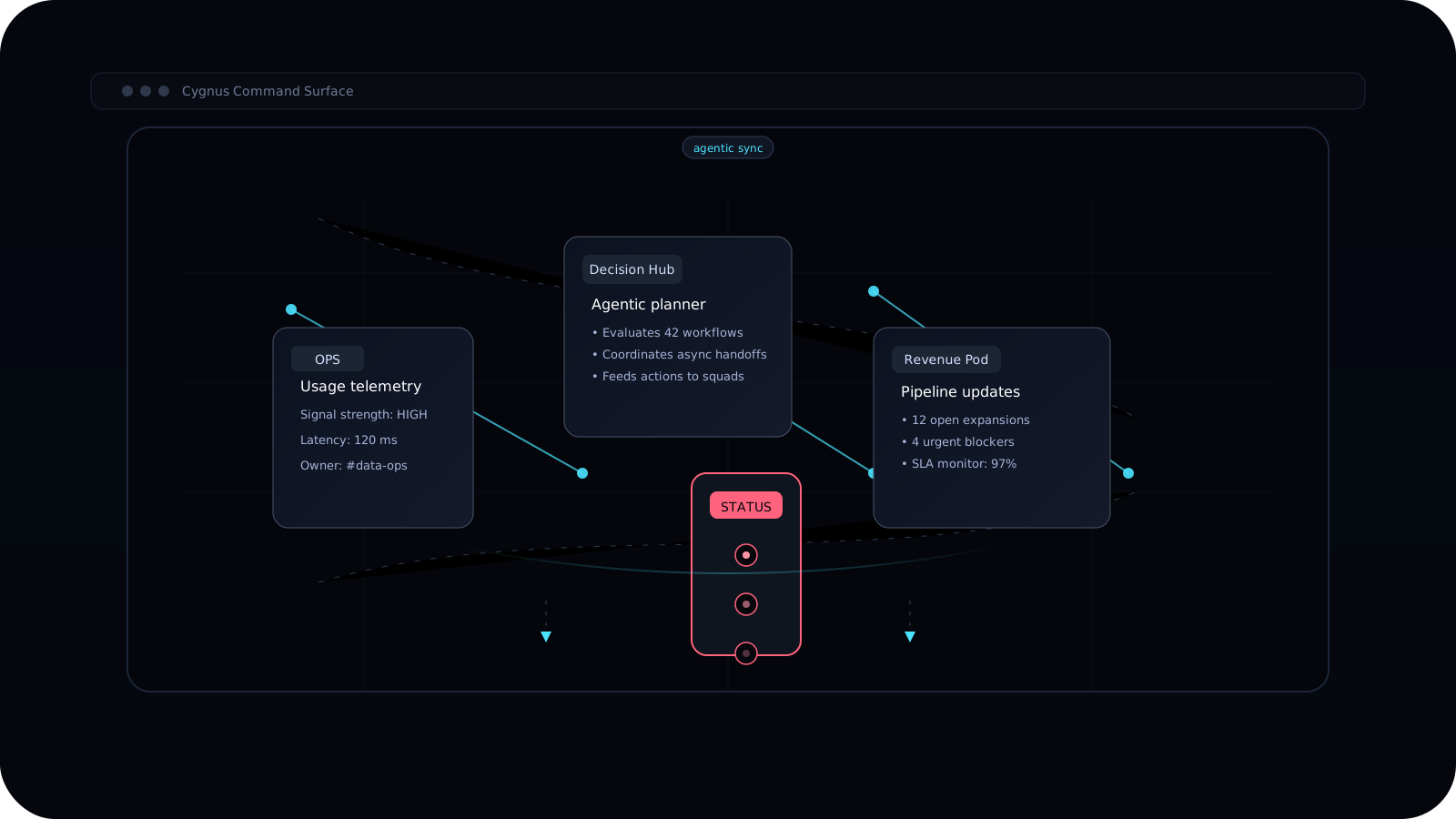
How Agentic Systems Will Redefine Enterprise Productivity
Enterprises today are at a turning point in automation. Traditional workflow tools — while effective for repetitive tasks — fall short when faced with the complex, cross-departmental, and asynchronous nature of real business operations. Enter agentic systems: autonomous AI-driven entities designed not merely to execute instructions but to understand goals, make decisions, and adapt dynamically.
As organizations shift from rule-based automation to adaptive intelligence, agentic systems are set to redefine how enterprises achieve productivity, collaboration, and efficiency.
What Are Agentic Systems?
An agentic system is an AI model or architecture that can plan, act, and reason independently. Unlike traditional automation — which follows fixed, pre-defined steps — agentic systems can:
- Interpret objectives and choose optimal paths dynamically.
- Pause or wait intelligently for human input or external triggers.
- Resume workflows autonomously once conditions are met.
- Collaborate with other agents or humans to complete multi-step processes.
In essence, agentic systems operate more like digital coworkers than static tools.
Why Traditional Automation Falls Short
Most enterprise automation platforms — from RPA bots to workflow orchestrators — are linear, synchronous, and rule-bound. They require detailed programming of every possible condition, and when something unpredictable occurs (a delay, a human approval, a missing input), the system breaks.
Limitations of Traditional Automation
- Rigidity: Each workflow must be designed step-by-step, leaving little room for flexibility.
- Maintenance Overhead: Even small changes require redesigning the entire process.
- Human Dependence: Processes still rely heavily on manual oversight.
- Scalability Issues: Hard to scale across departments due to complexity and fragmentation.
Agentic systems solve these problems by introducing autonomy, adaptability, and asynchronous collaboration.
How Agentic Systems Redefine Enterprise Productivity
Adaptive Decision-Making
Agentic systems continuously assess context and decide what to do next — without pre-programmed logic trees. This flexibility allows them to handle variations in workflows seamlessly, improving efficiency and reducing bottlenecks.
Example: Instead of halting when an approval is delayed, an agentic system pauses automatically and resumes once feedback arrives.
Asynchronous Execution
Unlike synchronous workflows that time out after minutes or hours, agentic systems can pause, sleep, and resume without breaking continuity. This enables long-running, multi-day business processes to stay automated end-to-end.
Human-Centric Collaboration
Agentic systems don’t eliminate humans — they work alongside them. With human-in-the-loop design, approvals, inputs, and decisions are integrated naturally into automation. This builds trust and encourages adoption across teams.
Cross-Functional Automation
Agents can communicate across departments — Finance, HR, Operations, and IT — bridging data silos and automating workflows that span multiple teams.
Continuous Learning and Optimization
Over time, agentic systems can analyze patterns in decision-making, improving accuracy and efficiency. This transforms automation from static execution to self-improving intelligence.
Real-World Applications in Enterprises
Finance & Compliance
- Automated expense validation and approvals.
- Continuous compliance checks and reporting.
- Adaptive budgeting and forecasting.
HR & Operations
- Candidate screening, offer generation, and onboarding workflows.
- Employee feedback analysis and task delegation.
- Attendance, payroll, and compliance workflows.
Sales & Customer Success
- Lead qualification and follow-up management.
- Multi-step proposal approvals and contract workflows.
- AI-generated insights on customer churn or upsell opportunities.
Benefits of Agentic Systems for Enterprises
- Higher Throughput: Automate multi-step workflows end-to-end without manual resets.
- Operational Resilience: Adaptive agents ensure continuity even under delays or uncertainty.
- Employee Empowerment: Teams focus on strategic work while agents handle execution.
- Scalability: One instruction can adapt to many use cases, cutting maintenance overhead.
- Trust & Transparency: Human approval loops ensure accountability.
The Role of Cygnus AI in Agentic Automation
Cygnus AI is a no-code platform designed to help enterprises build and deploy true agentic automation. It eliminates drag-and-drop complexity with an instruction-driven interface, enabling anyone to describe goals in natural language.
Its native asynchronous architecture lets agents pause, sleep, and resume intelligently — mirroring how real teams work. The Agent Inbox provides a centralized space for all approval and feedback requests, making AI-human collaboration seamless.
Cygnus AI bridges the gap between rigid automation and adaptive intelligence, enabling businesses to automate processes that were previously impossible to capture.
Traditional automation runs scripts. Cygnus AI builds coworkers.
The next wave of enterprise productivity will not come from faster scripts or more integrations — it will come from AI agents that can think, collaborate, and adapt.
Agentic systems represent a paradigm shift: from rule-based efficiency to goal-oriented intelligence. As platforms like Cygnus AI make this accessible to enterprises, the line between human and machine collaboration will blur — unlocking a new era of productivity, creativity, and scale.
Written by
Cygnus AI Team
Published October 26, 2025